
By Joanne Sun | November 2026
Most visitors leave Beijing’s Lama Temple with incense in their clothes, a hundred photographs on their phones and one urgent question: what now?
The usual answer is to get back on the subway.
The better answer is to keep walking.

Source: Dianping @风语者
Just beyond the temple lies one of central Beijing’s most satisfying neighborhoods: Wudaoying Hutong, Guozijian Street, Andingmen Inner Street and the smaller lanes connecting them. Imperial education, Tibetan Buddhism, grey-brick courtyards, residents carrying vegetables and young Beijingers carrying coffee all occupy the same compact piece of the city.
Andingmen is not an undiscovered village. Wudaoying has cafés and boutiques, the Lama Temple draws crowds, and certain courtyards have been polished within an inch of their Ming-dynasty lives. Yet the area still feels less like a tourist checklist than a neighborhood with somewhere to be.
Give it half a day. Start with history, wander without optimizing every minute, eat something warm and let the evening arrive naturally.

Source: Dianping @乘着晚风去旅行
Andingmen at a Glance
- Where: Northern Dongcheng District, inside Beijing’s Second Ring Road
- Best for: Hutong walking, temples, Chinese history, independent design and relaxed people-watching
- How long: 2–3 hours without major sights; 4–5 hours with the Lama Temple or Imperial College
- Best time: Weekday afternoon into early evening
- Nearest subway stations: Yonghegong Lama Temple on Lines 2 and 5; Andingmen on Line 2
- Cost: Walking the hutongs is free; museums and temples have their own admission rules
- Suggested route: Lama Temple → Guozijian Street → Wudaoying Hutong → Andingmen Inner Street
- Evening plan: Continue with Bridge to Locals’ Beijing nightlife experience on GetYourGuide

Why Is It Called Andingmen?
Andingmen (安定门) means the “Gate of Peace and Stability.” It was one of the nine gates of Beijing’s Ming- and Qing-era Inner City.
Traditional accounts connect the northern gate with troops returning after military campaigns: victory was followed by anding, the restoration of order. Beijing’s old gates also organized the city’s traffic and rituals. Grain, water, soldiers and imperial processions did not simply use whichever entrance looked convenient.
The gate itself is gone. Its defensive outer structure was removed as modern transport reshaped the capital, and most remaining city walls and gate towers disappeared during twentieth-century development. Today, traffic moves through Andingmen Bridge on the Second Ring Road where the old gateway once stood.

Source: Dianping @风语者
That sounds like a sad ending. It is not quite one.
The gate vanished, but its name still organizes the subway station, roads, neighborhood and mental map of Beijing. Behind it, the lanes preserve the old city’s human scale: walls close to the street, courtyard entrances half-hidden from view and turns that make a five-minute walk take forty-five.
The Beijing municipal government’s overview of the capital’s “Nine Old Gates” is a useful introduction to this vanished city system.
The Best Andingmen Walking Route
This route works in either direction, but beginning at the Lama Temple places the most time-sensitive attraction first. Cafés do not usually ring a bell and close their gates at 4:30 p.m. Temples do.
Stop 1: The Lama Temple
Allow: 60–90 minutes
Chinese name: 雍和宫 (Yōnghégōng)
Nearest subway: Yonghegong Lama Temple, Lines 2 and 5
The Lama Temple in Beijing began as an imperial residence before becoming a Tibetan Buddhist monastery. Its architecture brings together Han Chinese, Manchu, Mongolian and Tibetan influences, while its halls grow increasingly dramatic as you move north through the complex.
This is not merely an attractive collection of buildings. It remains an active religious site.
- Keep your voice low around worshippers.
- Follow current photography signs.
- Do not photograph people praying at close range.
- Wear clothing suitable for a religious space.
- Check ticket availability before arrival, especially on weekends and festival dates.
The official visitor information lists regular hours as:
- April 1–October 31: 9:00 a.m.–5:00 p.m.; last admission at 4:30 p.m.
- November 1–March 31: 9:00 a.m.–4:30 p.m.; last admission at 4:00 p.m.
Special-event schedules can differ, so confirm before visiting.

Source: Dianping @风语者
Stop 2: Guozijian Street
Allow: 30 minutes for the street; 60–90 minutes more for the museum
After incense and temple roofs, Guozijian Street feels unusually composed. Decorative archways, mature trees and restored façades create one of the most graceful short walks in the old city.
Its two major institutions explain the street’s importance:
- Beijing Temple of Confucius: A ceremonial site where emperors and officials honored Confucius.
- The Imperial College: China’s highest state educational institution during the Yuan, Ming and Qing dynasties.
Inside the combined museum complex, stone stelae preserve the names of successful examination candidates. Imagine studying for years so that your result could be carved in stone, then remember that modern students merely have to worry about screenshots circulating forever.
The Beijing government museum guide lists opening hours as 9:00 a.m.–5:00 p.m., with last entry at 4:30 p.m. It closes on Mondays except statutory holidays.

Source: Dianping @四根柏
Not entering the museum? The street itself is still worth walking. Look for:
- Traditional gateways and rooflines
- Small courtyards adapted for contemporary use
- Incense and fragrance shops drawing on older Chinese scent traditions
- Quiet side lanes where the souvenir traffic quickly thins out
Choose one shop that genuinely interests you. Visiting every photogenic doorway turns curiosity into inventory management.
Stop 3: Wudaoying Hutong
Allow: 45–90 minutes
Chinese name: 五道营胡同 (Wǔdàoyíng Hútòng)
Wudaoying runs for roughly 632 meters between Yonghegong Street and Andingmen Inner Street. It is often promoted as an “artistic hutong,” which is travel-writing shorthand for coffee, vintage clothing, handmade objects and at least one customer photographing a drink from six angles.
It is commercial, but it remains pleasant—especially on a weekday.

Source: Dianping @乘着晚风去旅行
Instead of chasing a list of named businesses, use these simple rules:
- Pick one café, not four. Choose a courtyard or window seat that feels inviting; independent businesses and opening hours change frequently.
- Browse by category. Look for ceramics, textiles, fragrance, paper goods or contemporary Chinese design rather than a specific viral shop.
- Notice the unrenovated details. Utility wires, bicycles, patched brickwork and residential doors tell more of the neighborhood’s story than perfect shopfronts do.
- Keep entrances clear. Wudaoying is also a residential lane, not a film set built around your portrait mode.
- Go slowly. Walking straight through takes minutes. Paying attention can occupy an hour.
Beijing’s official hutong guide describes Wudaoying as a 632-meter lane with 69 courtyards, stretching from Yonghegong Lama Temple Street to Andingmen Inner Street.
Stop 4: Andingmen Inner Street and the Smaller Lanes
Allow: 45–60 minutes
At Wudaoying’s western end, turn toward Andingmen Inner Street. The polished visitor version of the neighborhood begins to loosen.
The main road contains pharmacies, restaurants, delivery riders and daily errands. The side lanes hold grey-brick walls, courtyard gates and the kind of small urban surprises that cannot be efficiently ranked.
Look rather than collect:
- Old courtyard layouts reused for modern businesses
- Residents chatting beside doorways
- Bicycles and scooters performing advanced negotiations in narrow spaces
- Small food counters with short menus
- Rooflines visible above newer signs and air-conditioning units

Source: Dianping @乘着晚风去旅行
This is the point of Andingmen. The old and new are not displayed in separate galleries. They are arguing over parking space.
What Is a Hutong, Exactly?
A hutong (胡同) is a lane or alley traditionally associated with northern Chinese cities, especially Beijing. The word also refers more broadly to the neighborhood formed by those lanes and the courtyard homes, or siheyuan, arranged around them.

Source: Dianping @乘着晚风去旅行
Hutongs are not a single architectural era preserved in amber. A courtyard may have begun as one family residence, later been divided among several households and eventually acquired a studio, restaurant or shop. Plumbing, rent, preservation policy and tourism have all reshaped hutong life.
That is why the best hutong Beijing experience involves more than photographing grey bricks. Pay attention to how the space is being used now.
And remember:
- Do not look through residential windows or open private doors.
- Ask before photographing people.
- Keep voices down in narrow lanes.
- Do not block entrances while arranging a group photo.
The most beautiful courtyard you see may also be somebody’s exhausting Tuesday.
Coffee and Design Without the Free Advertising Directory
Andingmen’s commercial landscape changes too quickly for a permanent list of “must-visit” shops. A café can become a noodle bar before an English-language article notices. A boutique’s posted hours may be more aspirational than factual.
Use the neighborhood for discovery instead:
- For coffee: Choose a small courtyard café on Guozijian Street, Wudaoying or just off Andingmen Inner Street.
- For contemporary Chinese design: Look for ceramics, incense, textiles, stationery and domestic objects that reinterpret traditional materials.
- For gifts: Buy something made or designed in China, not a mass-produced object merely placed beside an old wall.
- For current information: Search the Chinese name in Amap, Apple Maps or Dianping on the day you visit.

Source: Dianping @苏婉揽清欢
The value is not completing a famous-shop checklist. It is seeing how a younger generation fits new habits—specialty coffee, scent, design and small-scale retail—inside older urban forms.
What to Eat Around Andingmen
Skip the pressure to reach one supposedly essential restaurant. The area is better approached through dishes.
Look for:
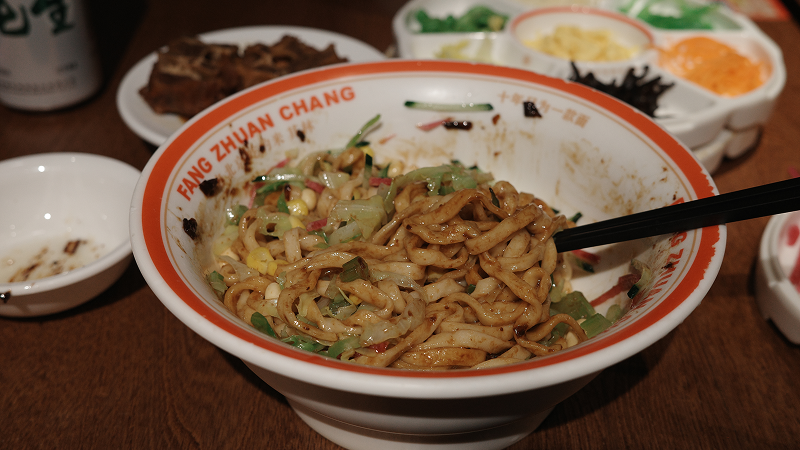
- Zhajiangmian (炸酱面): Wheat noodles with a rich fermented soybean-and-pork sauce
- Shaomai (烧卖): Open-topped steamed dumplings, often meat-filled in northern styles
- Baozi (包子): Steamed buns suitable for breakfast, lunch or the emotional emergency between museums
- Beef or lamb pastries: Crisp, layered dough with a savory filling
- Copper-pot mutton: A sociable cold-weather meal if you have more time
- Home-style stir-fries: Order several dishes to share rather than treating dinner as an individual administrative task

Source: Dianping @乘着晚风去旅行
Vegetarian and vegan travelers should confirm whether a dish contains meat stock, lard, egg, dairy or oyster sauce. “No visible meat” and “plant-based” are not always the same category.
If you are going out afterward, eat first. Beijing nightlife is much more charming when your dinner consisted of something other than cocktail garnish.
Three Ways to Build the Afternoon
The Two-Hour Version
- Begin at Yonghegong Lama Temple Station.
- Walk Guozijian Street without entering the museum.
- Cross Wudaoying Hutong.
- Finish near Andingmen Station.
The History-First Half Day
- Visit the Lama Temple when it opens.
- Explore the Temple of Confucius and Imperial College Museum.
- Have a late lunch or coffee.
- Walk Wudaoying and Andingmen Inner Street.
The Slow Afternoon-to-Night Version
- Start on Guozijian Street after lunch.
- Choose one museum, café or design stop.
- Walk Wudaoying in the late afternoon.
- Eat something around Andingmen.
- Continue into the hutongs after dark with a local host.

For that final step, Bridge to Locals’ Beijing nightlife experience on GetYourGuide offers a more social way to discover the city. Instead of advertising a dozen interchangeable bars and sending you to negotiate them alone, the experience adds the part a directory cannot provide: local company, conversation and context.

From Courtyard Coffee to Beijing After Dark
Andingmen changes gently at night. Museum doors close, commuters appear, restaurant tables fill and the hutongs become less about architecture than social life.
A daytime walk shows you what the neighborhood looks like. An evening with Beijing residents helps explain how it feels to live here: where friends meet, what people drink, how dating and work shape the city, and why everybody has a different definition of “the real Beijing.”

The Bridge to Locals Beijing nightlife experience is designed for travelers who want that transition—from observing a neighborhood to participating in an evening. It is best booked for the same night if you keep the afternoon relaxed, or for a separate evening if you plan to visit both major cultural sites.
No one will test you on the Nine Gates. But after one drink, somebody may explain all nine anyway.
Practical Tips for International Visitors
- Save Chinese place names: 雍和宫, 国子监街, 五道营胡同 and 安定门 are more useful to drivers and local map apps than English spellings.
- Use a current map: Amap generally has stronger local business data; Apple Maps is often easier for international visitors. Google Maps listings may be outdated in mainland China.
- Set up payment early: Alipay and WeChat Pay are widely used. Complete card verification before your walking day.
- Expect uneven surfaces: Comfortable shoes beat an ambitious outfit on old lanes.
- Check air and weather: Beijing afternoons can be windy in spring, hot in summer and sharply cold in winter.
- Avoid weekend peak time: Weekday late mornings and afternoons are usually calmer around Wudaoying and the Lama Temple.
- Confirm hours the same day: Small businesses change schedules; official attractions may alter admission during holidays and religious events.

Source: Dianping @乘着晚风去旅行
Frequently Asked Questions
Is Andingmen Worth Visiting?
Yes, especially if you want a compact area combining historic Beijing, active religious culture, hutongs and contemporary local life. It works best for travelers who enjoy walking and noticing details rather than moving between headline attractions.

Source: Dianping @乘着晚风去旅行
Is Andingmen Close to the Lama Temple?
Yes. Wudaoying Hutong directly connects the Lama Temple side of the neighborhood with Andingmen Inner Street. Walking from the temple area toward Andingmen is one of the easiest half-day routes in central Beijing.
What Are the Best Things to Do in Andingmen, Beijing?
Visit the Lama Temple, walk Guozijian Street, explore the Temple of Confucius and Imperial College, browse Wudaoying Hutong, try northern Chinese food and continue into Beijing’s hutongs after dark.
Is Wudaoying Hutong Free?
Yes. Wudaoying is a public street, so there is no admission fee. Individual shops, restaurants, temples and museums set their own prices and hours.
Is Wudaoying Better Than Nanluoguxiang?
They offer different experiences. Nanluoguxiang is larger, busier and more oriented toward mass tourism. Wudaoying is shorter and generally calmer, with cafés and independent shops, though it is no longer a secret local lane.
How Much Time Do I Need Around Andingmen?
Allow 2–3 hours for a relaxed neighborhood walk. Add 60–90 minutes for each major site—the Lama Temple or the Confucius Temple and Imperial College Museum.
What Is the Best Subway Stop?
Use Yonghegong Lama Temple Station on Lines 2 and 5 if starting with the temple. Use Andingmen Station on Line 2 if walking the route in reverse.
Final Thoughts
Andingmen’s gate has disappeared, but the neighborhood still performs the work of a gateway.
It leads from imperial Beijing to the living city: from examination stelae to coffee cups, temple incense to delivery scooters, carefully restored courtyards to homes where somebody is trying to bring in the washing.
Come for the Lama Temple. Stay because the next street looks interesting. Resist the urge to turn every shop into a mission.
Then, when the roofs disappear into the evening, let someone local show you what happens after the sightseeing ends.

Source: Dianping @乘着晚风去旅行





Leave a comment
This site is protected by hCaptcha and the hCaptcha Privacy Policy and Terms of Service apply.