
By Sherry Fei | April 2026
China doesn’t present itself all at once. It reveals itself in layers—mist rising from mountains, stone walls stretching beyond sight, neon lights reflecting on rivers.
If you’re planning a trip, knowing the key landmarks in China helps you understand not just where to go, but what kind of country you’re stepping into: ancient, vast, and constantly evolving.
Here’s a curated guide to the most famous landmarks in China—natural wonders, historical icons, and modern cityscapes that define the country.

Source: 小红书@高高~小香猪🐷在富士
Zhangjiajie National Forest Park
China’s most surreal natural landmark.
If there’s one place that feels almost unreal, it’s Zhangjiajie National Forest Park. Towering sandstone pillars rise straight into the clouds, forming one of the most recognizable landscapes in China.
This UNESCO-listed site inspired the floating mountains in Avatar, but in real life, it feels even more dramatic. Walking paths wind through dense forest, glass bridges stretch across deep valleys, and viewpoints open up to endless layers of peaks.
Why visit:
- Iconic pillar landscapes unique to China
- Glass bridge and skywalk experiences
- One of the most photographed China natural landmarks

Source: 小红书@荷子畫事
West Lake, Hangzhou
A poetic landscape shaped by centuries.
West Lake is not just scenery—it’s a composition. Bridges, willows, pagodas, and distant hills all arranged like a traditional painting.
It has been inspiring poets and artists for over a thousand years. The experience here is slow: walking along the causeways, drifting on a wooden boat, or simply watching the light change over the water.
Why visit:
- One of the most famous places in China for classical beauty
- A UNESCO cultural landscape
- Best experienced through walking and boat rides

Source: 小红书@路上一只熊
The Forbidden City, Beijing
The heart of imperial China.
In the center of Beijing stands the Forbidden City, a vast palace complex that once housed emperors for nearly 500 years.
Walking through its gates feels like stepping into a different scale of history. The symmetry, the colors, the sheer size—it’s designed to overwhelm.
Why visit:
- One of the most important China historical landmarks
- Largest ancient palace complex in the world
- Essential stop for understanding imperial China

Source: 小红书@Chika
The Bund, Shanghai
Where old Shanghai meets the future.
The Bund is not ancient—but it’s iconic.
On one side, colonial-era buildings line the waterfront. Across the river, futuristic skyscrapers define modern China. At night, the contrast becomes even sharper, with lights reflecting off the Huangpu River.
Why visit:
- One of the most recognizable China landmarks in global media
- Best skyline views in the country
- A snapshot of China’s transformation

Source: 小红书@Slowyjz
Chengdu Research Base of Giant Panda Breeding
The softest landmark you’ll ever visit.
Not all landmarks are architectural. Some are alive.
Chengdu’s panda base offers a rare chance to see giant pandas up close in a carefully designed environment. Early mornings are the best time—when pandas are most active.
Why visit:
- One of the most visited landmarks in China
- Unique wildlife experience
- A symbol of China worldwide

Source: 小红书@猪么么儿
Yellow Crane Tower, Wuhan
A landmark of poetry and legend.
Perched above the Yangtze River, the Yellow Crane Tower is one of the most famous towers in Chinese history.
It has been destroyed and rebuilt multiple times, yet its cultural significance never faded. For centuries, poets wrote about it as a place of departure, nostalgia, and reflection.
Why visit:
- Deep literary and historical meaning
- Panoramic river views
- A classic stop in central China

Source: 小红书@Percy(📸旅行记录版)
The Great Wall
China’s most legendary structure.
Stretching across mountains and deserts, the Great Wall is perhaps the most famous landmark in China.
Different sections offer different experiences—from restored and accessible to wild and untouched. Walking along it, you begin to understand the scale of ancient ambition.
Why visit:
- One of the most famous landmarks in the world
- A UNESCO World Heritage site
- Multiple sections to explore near Beijing

Source: 小红书@Rhys.H
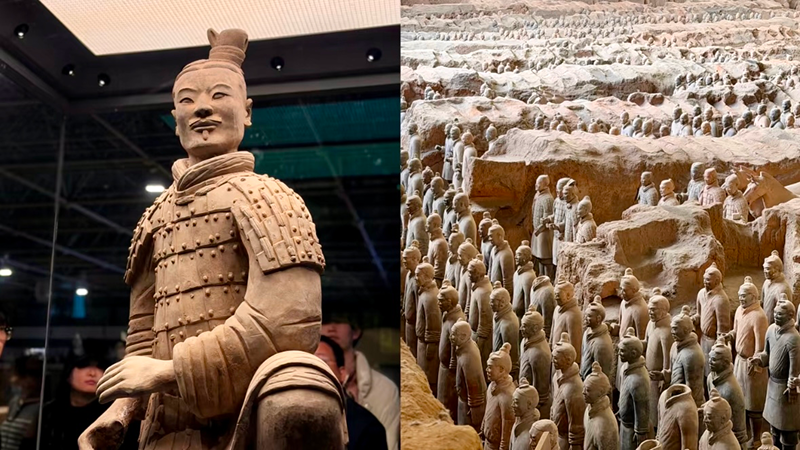
Terracotta Army, Xi’an
An underground army frozen in time.
Discovered by accident in 1974, the Terracotta Army guards the tomb of China’s first emperor.
Thousands of life-sized soldiers stand in formation, each with unique facial features. It’s one of the most astonishing archaeological finds in the world.
Why visit:
- A key China UNESCO site
- Incredible craftsmanship and historical depth
- A glimpse into ancient imperial power

Source: 小红书@舜游记
Guilin & Li River
China’s most iconic river landscape.
Karst mountains rise sharply along the Li River, creating one of the most photographed natural landscapes in China.
A boat ride here feels calm and cinematic—mist drifting over peaks, fishermen on bamboo rafts, water reflecting everything.
Why visit:
- Classic China natural landmarks scenery
- Ideal for slow travel and photography
- Often featured in traditional Chinese paintings

Source: 小红书@携程旅行
When to Visit These Landmarks
Timing matters more than you think.
Avoid major public holidays like:
- Labor Day (early May)
- National Day Golden Week (early October)
During these periods, even the most remote landmarks in China become extremely crowded. To learn more about China’s peak travel seasons and how to avoid the crowds, be sure to read our feature blog on the topic: China Public Holidays 2026: A Practical Travel Guide to Avoid Crowds and Choose the Best Time to Visit.
For a better experience:
- Travel in late March–April or October–November
- Visit popular sites early in the morning
- Choose lesser-known routes when possible

Source: 小红书@携程旅行
Beyond the Landmarks
Landmarks show you the highlights—but they don’t show you how people actually live.
That’s where local experiences come in.
At Bridge to Locals, we’ve built experiences around these destinations—walking through markets near historic sites, exploring nightlife after visiting landmarks, or discovering cultural rituals that don’t appear on maps.
If you’re planning your trip, you can explore:
- Beijing Hutong nightlife with local drinking tour
- Chinese character meditation experience at Shanghai Jade Buddha Temple
- Hangzhou Food Tour: Market Walk and Local Snacks
- Enjoy Hangzhou like an aristocrat: West Lake cruise, tea tasting, painting
- Chengdu Nightlife: Explore hidden bars with local friends
- Beijing Nightlife: Explore vintage movie-themed bars and hutongs
- Hangzhou nightlife: historical bars, live music, and local markets
- Wuhan Breakfast Walk: Markets, street food, and specialty coffee
- Shanghai Nightlife: TCM Cocktails
Because the best way to understand a place isn’t just to see it—it’s to spend time inside it.






Leave a comment
This site is protected by hCaptcha and the hCaptcha Privacy Policy and Terms of Service apply.