
By Sherry Fei | July 2026
The Dragon Boat Festival is one of the most vivid traditional Chinese festivals for foreign travelers to experience in China. It is loud, emotional, and wonderfully physical: drums beat over the water, paddlers move as one, crowds gather along riverbanks, and the smell of bamboo leaves rises from freshly steamed zongzi.
For travelers interested in Chinese festivals and traditions, the Dragon Boat Festival is a perfect doorway into Chinese culture. It is not only a holiday on the calendar. It is a festival of memory, teamwork, food, summer customs, and local identity. In 2026, the Dragon Boat Festival date is June 19, and the mainland China public holiday runs from June 19 to June 21.

Source: 小红书@艾艾艾伦
What Is the Dragon Boat Festival?
The Dragon Boat Festival, also known by its romanized name Duanwu, falls on the fifth day of the fifth month of the Chinese lunar calendar. Because it follows the lunar calendar, the date changes every year on the Gregorian calendar. That is why many travelers search “when is Dragon Boat Festival” before planning a China trip.
The two most famous Dragon Boat Festival traditions are dragon boat racing and eating zongzi, or Chinese rice dumplings wrapped in bamboo or reed leaves. In 2009, UNESCO inscribed the Dragon Boat Festival on the Representative List of the Intangible Cultural Heritage of Humanity, recognizing it as a living tradition with deep cultural value.

Source: 小红书@👑魚子☀️貓味👑
Dragon Boat Festival Meaning and History
The best-known Dragon Boat Festival history is connected with Qu Yuan, a poet and minister from the Warring States Period. According to the popular story, Qu Yuan was loyal to his state but was exiled after political conflict. When he later heard that his homeland had fallen, he drowned himself in the Miluo River. Local people are said to have raced out in boats to search for him and thrown rice into the water to keep fish away from his body. Over time, this story became tied to dragon boat races and zongzi.
This legend gives the Chinese Dragon Boat Festival its emotional core: loyalty, grief, public memory, and community action. But the festival is older and broader than one story. The fifth lunar month arrives as summer heat, insects, humidity, and illness become stronger, so older customs were also about protection. Families hung aromatic herbs, made scented sachets, and used seasonal rituals to welcome a safer summer.
That mix is what makes the festival so interesting. It is at once patriotic, poetic, practical, and festive.

Source: 小红书@WEI森川景
Dragon Boat Festival Traditions
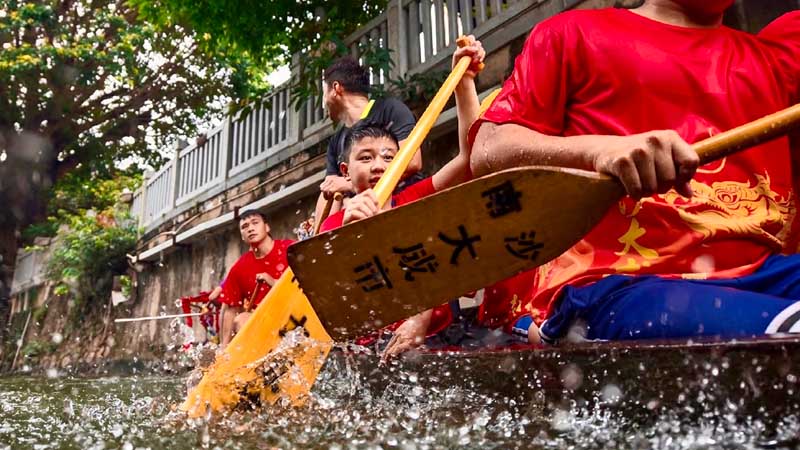
The most spectacular tradition is the dragon boat race. A dragon boat is long and narrow, often decorated with a dragon head and tail. The drummer sits near the front, setting the rhythm while the paddlers move together. Watching a race in person is very different from seeing photos. You hear the drum first, then the shouting, then the water breaking as the boats rush forward.
The most intimate tradition is zongzi. These Chinese rice dumplings are made with sticky rice wrapped in leaves and then steamed or boiled. Fillings vary by region. Some are sweet, with red dates or bean paste. Others are savory, with pork, salted egg yolk, mushrooms, beans, or chestnuts. This is why Dragon Boat Festival food is one of the easiest ways to understand regional China.
Other Dragon Boat Festival activities include making scented sachets, hanging mugwort, joining community markets, watching folk performances, and sharing festival food with family or friends. Some older customs, such as drinking realgar wine, are now more symbolic than practical, and travelers do not need to try everything to understand the festival.

Source: 小红书@momo
Zongzi: The Food That Tastes Like a Holiday
Zongzi may look simple, but it carries a lot of memory. The first thing you notice is the smell of the leaves. Then comes the rice: soft, sticky, and warm. A sweet zongzi can feel gentle and comforting. A savory pork zongzi can feel rich enough to be a full meal.
In China, zongzi is not just bought and eaten. People compare styles, gift boxes, family recipes, and regional preferences. Some families still wrap zongzi at home before the holiday. Markets and hotels also create seasonal versions, from classic pork and egg yolk to more modern flavors. For travelers, the best approach is simple: try one sweet and one savory, then decide which side of the zongzi debate you are on.

Source: 小红书@LuLuLu
Dragon Boat Festival in Modern China
Today, China Dragon Boat Festival celebrations combine old customs with modern city life. Some people return home for family meals. Some take a three-day trip. Others go to parks, waterfronts, museums, shopping streets, or food markets. In many cities, the holiday now feels like a mix of cultural festival, sports event, and short summer break.
This is also why the Dragon Boat Festival is becoming more attractive to international visitors. It offers something that major landmarks cannot always provide: a chance to see culture happening in real time. Instead of only visiting a temple or museum, travelers can stand beside a river with local families, watch a dragon boat race, eat zongzi, and feel the city change for the holiday.

Source: 小红书@日光山野
Best Cities to Experience Dragon Boat Festival in China
Hangzhou is one of the best places for a scenic Dragon Boat Festival China trip. Xixi Wetland is known for dragon boat culture, wetland views, tea pavilions, zongzi activities, and folk performances, making it a strong choice for travelers who want a softer water-town atmosphere.
Guangzhou offers a more powerful southern version of the festival. In 2026, Guangzhou’s Tianhe District is preparing a month-long Dragon Boat Festival program with more than 100 events across its waterways, including village invitation gatherings and competitive dragon boat races.
Hong Kong is ideal for travelers who want an international waterfront spectacle with English-friendly information. The 2026 Sun Life Hong Kong International Dragon Boat Festival runs from June 19 to July 1, with international races on June 27 and 28 at the Tsim Sha Tsui Promenade.
Macao is another strong Greater Bay Area option. The 2026 SJM Macao International Dragon Boat Races are scheduled for June 13, 14, and 19 at Nam Van Lake Nautical Centre.
Hunan and Hubei are meaningful for travelers interested in Qu Yuan and the deeper Dragon Boat Festival meaning. These regions connect the holiday to rivers, poetry, local memory, and historical storytelling.
Suzhou is a good choice for travelers who prefer canals, gardens, and a slower Jiangnan mood. It pairs well with Hangzhou for a softer festival route focused on water, food, and old streets.

Source: 小红书@檔主出门了
Suggested Dragon Boat Festival Routes
For a first-time cultural route, choose Hangzhou and Suzhou. Spend one day around Xixi Wetland or the Grand Canal, then continue to Suzhou for gardens, canals, zongzi, and relaxed local walks.
For a lively southern route, choose Guangzhou, Hong Kong, and Macao. This route gives you village customs, major waterfront races, Cantonese food, harbor views, and a strong festive crowd.
For a history-focused route, choose Hunan and Hubei. This is better for travelers who want to understand Qu Yuan, river legends, and the older layers of Dragon Boat Festival history.
A local companion can make these routes feel less like sightseeing and more like participation. With Bridge to Locals, travelers can visit festival markets, learn how locals choose zongzi, understand the stories behind the races, and turn a public holiday into a personal cultural exchange.

Source: 小红书@二姐与橘猫
Related Bridge to Locals Blogs and Experiences
The Dragon Boat Festival is exactly the kind of cultural moment Bridge to Locals was created for. Bridge to Locals connects visitors with local companions rather than conventional tour guides. That means your festival experience can include real conversation, food discovery, local customs, neighborhood walks, and stories that are hard to find on a standard itinerary.
On the Bridge to Locals website, travelers can continue exploring related blogs and experiences below such as Hangzhou Dragon Boat Festival Guide, China City Walks, China Night Markets Guide, Cherry Blossoms in China, Chengdu Nightlife Walk, Mahjong Experience, Temple Meditation Experience, and flexible local food routes designed for visitors who want more than standard sightseeing.
- Beijing Hutong nightlife with local drinking tour
- Beijing Nightlife: Explore vintage movie-themed bars and hutongs
- Yangmeizhu Hutong Old Beijing Culture and Handicraft Tour
- Shanghai Nightlife: TCM Cocktails
- Chinese character meditation experience at Shanghai Jade Buddha Temple
- Hangzhou Food Tour: Local Bazaar and Street Food Walking Tour
- Chinese Food Philosophy in Hangzhou: A Zen Food Journey
- Hangzhou nightlife tour: bars, cocktails, beer and night markets
- Tea varieties in Hangzhou: DIY kombucha, Longjing tea, matcha
- Enjoy Hangzhou like an aristocrat: West Lake cruise, tea tasting, painting
- Wuhan Breakfast Walk: Markets, street food, and specialty coffee
- Chengdu Nightlife: Explore hidden bars with local friends
The Dragon Boat Festival is one of the best traditional Chinese festivals for travelers because it is easy to see, hear, taste, and feel. You do not need to understand every historical detail before you arrive. Stand by the water, listen to the drum, watch the paddlers move together, unwrap a warm zongzi, and the meaning begins to make sense. This is one of the most rewarding times to visit China. Come for the race, but stay for the local stories. Bridge to Locals can help you find them.






Leave a comment
This site is protected by hCaptcha and the hCaptcha Privacy Policy and Terms of Service apply.