
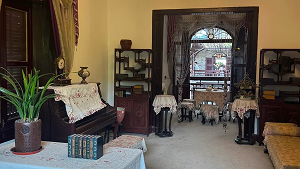
Tucked quietly in Suzhou’s old city, away from the crowds of the Humble Administrator’s Garden and the bustling flow of Pingjiang Road, lies a lesser-known gem—Master of the Nets Garden (网师园).
More than just a classical Chinese garden, this is a place of subtle elegance, perfect proportion, and poetic spirit. Though far smaller than Suzhou’s other UNESCO-listed gardens, the Master of the Nets Garden is considered by many experts to be the finest example of how small spaces can hold infinite worlds.

More than just a classical Chinese garden, this is a place of story—of elegance and rebellion, of architectural brilliance and quiet female strength. Once home to the remarkable He family, Master of the Nets Garden in Suzhou is a living memory of a time when women began to shape the future from within walls of tradition.
1. What Is Master of the Nets Garden?
Location: No. 11 Kuojiatou Lane, Dai Cheng Qiao Road, Suzhou, Jiangsu Province (江苏省苏州市姑苏区阔家头巷11号)
Opening Hours: 8:00 AM – 5:00 PM
Tickets: ¥30–¥40 depending on season
Originally dating back to the Southern Song Dynasty (12th century), the garden was later restored in the Qing Dynasty. The name “Master of the Nets” reflects the ideal of a scholar seeking simplicity and peace, much like a fisherman casting nets to live humbly.
2. What Makes He Garden Special?
Small but Perfectly Formed
At only about half a hectare, the garden is tiny compared to others—yet its design makes it feel expansive. Every turn offers a new framed scene, balancing water, rock, plant, and architecture.

The Central Pond
At the heart is a large pond surrounded by pavilions, bridges, and winding corridors. Lotus flowers bloom in summer, reflecting in the water like living brushstrokes.
The Residential Touch
Unlike some gardens built purely for display, the Master of the Nets Garden combines living quarters and scholar’s studios. This makes it feel more like a home—where people truly read, painted, and entertained.
Moon Gates and Windows
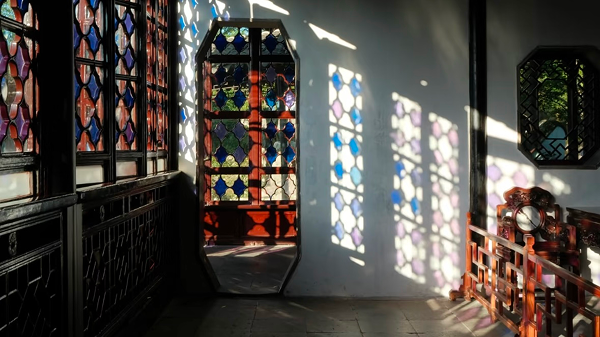
Intricate lattice windows and moon gates turn every view into a painting. The garden is often studied by architects worldwide for its mastery of perspective.

Bridge with Locals Tip:
Visit in the early morning when the corridors are empty and Suzhou’s soft light creates magical reflections in the ponds.
3. The Owners of Master of the Nets Garden: Three Sisters & Their Legacy
Master of the Nets Garden isn’t just bricks and bamboo—it’s the cradle of three of the most extraordinary women in 20th-century China:

He Zehui (何泽慧): The Physicist
Known as “China’s Madame Curie”, she studied physics in Berlin, worked under Nobel laureate Walther Bothe, and later co-led China's early nuclear research with her husband Qian Sanqiang. She was among the first women in China to enter a high-level STEM field—and her journey began here, in a private study room off the garden.
He Yizhen (何怡贞): The Chemist
A pioneer in crystallography, she studied at the University of Chicago and became one of China’s first female PhDs in physical chemistry. Quiet and deeply intelligent, she returned to Yangzhou to teach young girls science at a time when such a thing was radical.
He Zeying (何泽瑛): The Diplomat
The most politically involved of the sisters, Zeying became an advocate for women’s education and social reform, often attending global conferences and encouraging cultural diplomacy long before the phrase became popular.
4. Experience Master of the Nets Garden In a Meaningful Way
Beyond its elegant pavilions and winding corridors, Master of the Nets Garden carries a legacy that stretches far beyond Suzhou—into some of the world’s most respected institutions of science.

He Yizhen (何怡贞), the eldest of the He sisters, was a pioneer in physical chemistry. She earned her PhD from the University of Michigan in 1933, and her early crystallography work laid the foundation for modern structural analysis in China.
Her younger sister, He Zehui (何泽慧), trained in nuclear physics at the Kaiser Wilhelm Institute in Heidelberg (now the Max Planck Institute for Medical Research), under Nobel laureate Walther Bothe. With his mentorship, she explored radioactive particles and cosmic rays, later collaborating with Heinz Maier-Leibnitz on cloud chamber techniques. Her research bridged the gap between experimental nuclear science and particle physics, at a time when few women—anywhere—were present in these conversations.
She also spent time at the Curie Laboratory in Paris, contributing to uranium fission studies. When once asked how she managed to contribute to major discoveries, she replied with characteristic sharpness:
“Discoveries are easy, really—just do your work carefully. Anyone can discover something. Unless, of course, they spend all day not thinking.”
Together, the sisters’ lives traced a web between Suzhou’s stone corridors and Europe’s scientific vanguard, between quiet garden pavilions and the laboratories of Chicago, Heidelberg, and Geneva.

The Master of the Nets Garden holds not just stories of Suzhou’s past, but the intellectual footprints of women who moved confidently across continents, disciplines, and eras.
Why Visit Master of the Nets Garden with Bridge to Locals?
Master of the Nets Garden is more than a scenic stop—it’s a space rooted in daily life, ideas, and quiet revolution. With Bridge with Locals, your visit can be enriched:
- We can help arrange customized Republic of China–era clothing rentals, so you can walk with the locals in the garden dressed as people did in the He family’s time.
- Sit down for tea in a nearby courtyard with someone who lives in Suzhou today—perhaps a local historian, teacher, or student. Talk about the He sisters’ legacy, how education has changed, or simply exchange views on everyday life in China. This is a way to live localy.
- A local host fluent in Chinese can help interpret plaques, classical poems, or staff conversations, making your experience smoother and richer.
We match you with people who are genuinely connected to the place, not just tour guides. It’s about building real, respectful cultural encounters.





Leave a comment
This site is protected by hCaptcha and the hCaptcha Privacy Policy and Terms of Service apply.