
By Sherry Fei | May 2026
Beijing’s Underground City has reopened — and it feels like entering another world.
Most travelers imagine Beijing through imperial palaces, crowded hutongs, roast duck restaurants, and glowing skyscrapers.
But beneath the city?
There is another Beijing.
A hidden underground network built during one of the most tense periods of modern Chinese history has quietly reopened to the public — and it may become one of the most fascinating stops for travelers interested in history, urban exploration, and dark tourism.
Known for decades as the “Beijing Underground City,” this massive underground bunker system has officially reopened as the Beijing Civil Air Defense History Museum.
And yes: admission is currently free.
For travelers planning a Beijing tour beyond the usual Forbidden City checklist, this place offers something very different — a rare chance to step inside one of China’s most mysterious underground cities.

Source: 小红书@有空w
What Is the Beijing Underground City?
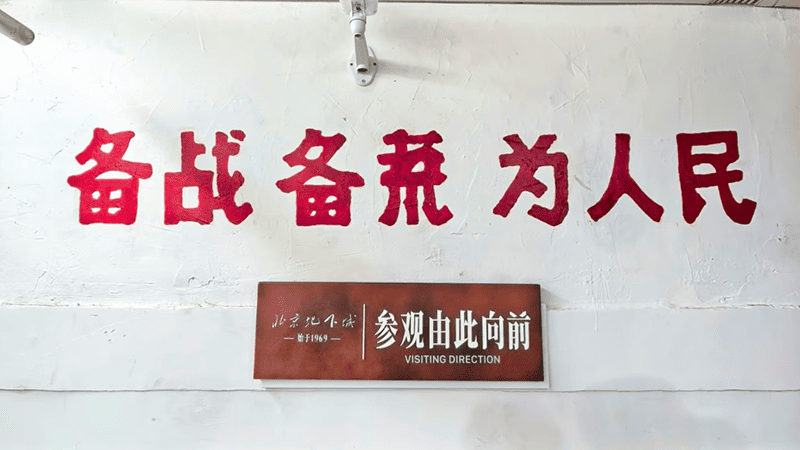
The Beijing Underground City was originally constructed in 1969 during the Cold War era.
At the time, China was deeply concerned about the possibility of military conflict and air raids. Across the country, large-scale civil defense projects were launched under the slogan often translated as:
“Dig deep tunnels, store grain everywhere.”
The underground complex beneath Beijing’s Dongcheng District became one of the capital’s largest and most complete early air-defense tunnel systems.
Construction reportedly took nearly a decade.
Unlike modern museums built to imitate history, this underground city is the real thing: narrow tunnels, preserved bunker structures, underground halls, old facilities, and passageways originally designed for emergency wartime shelter.
For years, many Beijing locals simply referred to the area as “Beijing Underground City” because of a sign once hanging near the entrance.

Source: 小红书@有空w
Why It Closed — And Why It Matters Now
The underground city gradually faded from public attention after closing in 2008.
For many younger residents, it became more rumor than reality — one of those strange hidden places people heard about but rarely visited.
Now, after years of renovation and redevelopment, the site has reopened with a completely different identity.
The new Beijing Civil Air Defense History Museum transforms the old bunker into a hybrid space combining:
- Cold War history
- Civil defense education
- Military technology exhibitions
- Urban heritage preservation
- Interactive VR experiences
What makes the experience especially striking is that the original underground structure itself remains largely intact.
Walking down the long staircase into the tunnels genuinely feels like entering another era.

Source: 小红书@有空w
Inside the Underground City
The newly reopened exhibition space covers roughly 2,500 square meters underground.
And the atmosphere is surprisingly immersive.
Old newspapers, historical photographs, propaganda materials, vintage equipment, and preserved bunker layouts create a heavy sense of time frozen beneath modern Beijing.
The exhibition follows the broader history of Beijing’s civil defense system and national mobilization efforts during the twentieth century.
But the museum also adds a modern layer.
Inside the former underground assembly hall, visitors now find models of advanced Chinese military and aerospace technology, including:
- J-20 fighter jets
- Long March rockets
- Spacecraft return capsules
- Lunar rover models
There are even VR experiences allowing visitors to interact with military and aerospace simulations.
The contrast is surreal:
Cold War tunnels below ground.
Futuristic technology displays inside them.
It almost feels like stepping into a hidden bunker level from a sci-fi game.
Honestly, travelers interested in hidden bunker arc raiders aesthetics, abandoned military spaces, or underground exploration culture will probably find this place unexpectedly fascinating.

Source: 小红书@有空w
Why This Place Appeals to Dark Tourism Travelers
The term “dark tourism” usually brings to mind places connected to war, political tension, or historical anxiety.
The Beijing Underground City fits into that category in a uniquely Chinese way.
Unlike heavily commercialized Cold War attractions elsewhere, this site still feels relatively understated and local.
There are no theatrical actors or exaggerated horror effects.
Instead, what makes the experience powerful is the realism.
You are standing inside infrastructure built for a possible wartime scenario beneath one of the world’s busiest modern capitals.
And above ground?
People are ordering bubble tea, riding scooters, and taking selfies in nearby hutongs.
That contrast gives the underground city its strange emotional weight.

Source: 小红书@有空w
Where Is the Beijing Underground City?
The museum is located in Tongle Hutong in Dongcheng District, near the Qianmen area of central Beijing.
This makes it surprisingly easy to combine with other popular Beijing tour stops, including:
- Qianmen Street
- Tiananmen area
- Dashilar hutongs
- Temple of Heaven
- Nanluoguxiang
- Beijing food walks
Unlike some distant military museums, this one sits directly inside one of Beijing’s most historically layered neighborhoods.
You can literally spend the morning exploring imperial Beijing and the afternoon walking through Cold War tunnels underground.

Source: 小红书@小冠军
Opening Hours and Visitor Information
Beijing Underground City Visitor Guide
Location:
Tongle Hutong, Dongcheng District, Beijing
Opening Hours:
Tuesday to Sunday
9:00 AM – 5:00 PM
Closed on Mondays for maintenance.
Tickets:
Currently free with reservation.
Visitors can reportedly reserve through online mini-program systems or register on-site depending on availability.
Because the site has only recently reopened, visitor policies may continue changing as popularity grows.

Source: 小红书@小田鼠
Is the Beijing Underground City Worth Visiting?
Honestly? Yes — especially if you have already visited Beijing’s major landmarks before.
The Forbidden City tells the story of imperial China.
The Underground City tells the story of modern China’s anxieties, survival instincts, and urban transformation.
And unlike many standard tourist attractions, this place still feels relatively undiscovered internationally.
For travelers interested in:
- underground cities
- Cold War history
- dark tourism
- hidden military spaces
- unusual Beijing tour ideas
- urban exploration aesthetics
- futuristic bunker environments
…it is easily one of the most unique places currently open in Beijing.

Source: 小红书@七月的角落
Beijing Above Ground Is Only Half the Story
One thing we always tell travelers at Bridge to Locals:
China becomes much more interesting once you stop looking only at the surface.
Sometimes that means hidden noodle shops inside hutongs.
Sometimes it means rooftop bars above neon skylines.
And sometimes it means descending beneath Beijing itself into a Cold War tunnel system forgotten for years.
If you enjoy discovering the stranger, more layered side of China, we also publish independent blogs and local experiences covering:
- Beijing Hutong nightlife with local drinking tour
- Beijing Nightlife: Explore vintage movie-themed bars and hutongs
- Yangmeizhu Hutong Old Beijing Culture and Handicraft Tour
- Shanghai Nightlife: TCM Cocktails
- Chinese character meditation experience at Shanghai Jade Buddha Temple
- Hangzhou Food Tour: Local Bazaar and Street Food Walking Tour
- Chinese Food Philosophy in Hangzhou: A Zen Food Journey
- Hangzhou nightlife tour: bars, cocktails, beer and night markets
- Tea varieties in Hangzhou: DIY kombucha, Longjing tea, matcha
- Enjoy Hangzhou like an aristocrat: West Lake cruise, tea tasting, painting
- Wuhan Breakfast Walk: Markets, street food, and specialty coffee
- Chengdu Nightlife: Explore hidden bars with local friends
Because some of the most memorable places in China are not the ones printed on postcards.
They’re the ones hidden beneath the city.





1 comment
Graham Wardrope
Looks brilliant, i am in china and looking to go, who do i contact to make reservation?
Leave a comment
This site is protected by hCaptcha and the hCaptcha Privacy Policy and Terms of Service apply.