
By Sherry Fei | March 2026
Let’s start with the part everyone actually Googles:
Yes, you can survive the China metro. Even as a foreigner.
Here’s the quick guide:
- Payment: Use Alipay or WeChat to scan QR codes directly at the gate
- Tickets: Available at machines (English supported in most cities)
- Navigation: Apple Maps and Baidu Maps both work well for metro routes
- Language: Stations usually have English signs and announcements
- Security check: Yes, your bag will be scanned. Every time.
It’s efficient, mostly intuitive, and surprisingly foreigner-friendly.
And yet—
this is where things get interesting.

Source: 小红书@没事就好photograph📷
Order vs Chaos
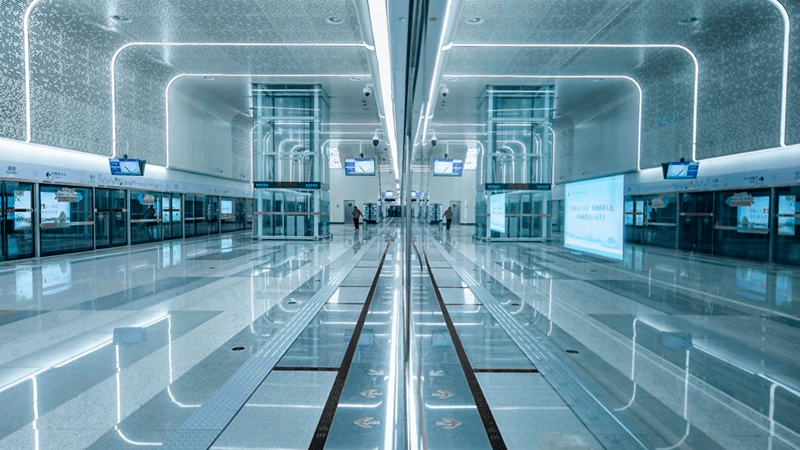
At first glance, the China metro feels almost unnervingly orderly. People line up. There are arrows on the floor. Some cities even have platform staff choreographing human movement like it’s a live performance.
And then the doors open.
Suddenly, the system stress-tests itself:
- people rushing in
- people trying to get out
- that one person who absolutely refuses to wait
It’s not quite chaos.
It’s more like controlled chaos with a shared understanding.
Somehow, it works.

Source: 小红书@Brandon布莱登子🎬
Security vs Freedom
If you’ve taken the London Underground or the New York City Subway, the first thing that will hit you is this:
China metro feels like entering an airport.
Every station:
- bag scan
- occasional manual checks
- visible security presence
It’s not subtle.
And depending on where you’re from, it can feel:
- reassuring
- intrusive
- or just… different
But here’s the trade-off:
The system feels extremely safe and controlled;
The cost is a bit less spontaneity.
Freedom is slightly filtered. Security is heavily engineered.

Source: 小红书@小叶叶
Technology vs Humanity
China’s metro system is one of those places where you really feel the country’s tech acceleration.
- QR code everything
- seamless mobile payments
- real-time navigation
- ultra-fast train frequency
In cities like Shanghai or Shenzhen, it can feel borderline futuristic.
And yet, right next to all that:
- someone watching dramas out loud
- a grandma carrying vegetables at 8am
- a kid spinning around the pole like it’s a playground
The system is advanced.
The people inside it are… very human.
And that contrast is the real experience.

Source: 小红书@没事就好photograph📷
Crowded vs Efficient
Let’s not romanticize it: Yes, it gets crowded. Very crowded.
Rush hour in cities like Beijing can feel like:
“Am I still an individual or have I become part of a moving organism?”
But here’s the twist:
Trains come every 2–5 minutes;
Lines are extensive;
Transfers are well-designed.
So even when it feels overwhelming, you’re still moving fast. It’s not comfortable. But it’s incredibly effective.

Source: 小红书@没事就好photograph📷
A Small Detour: The Case of Fuzhou Metro
Now let’s talk about something more niche.
Take Fuzhou — not exactly the first city that comes to mind for international travelers.
Its metro system isn’t as massive as Beijing or as flashy as Shanghai.
But that’s exactly why it’s interesting.
Here, the experience feels… scaled down:
- fewer crowds
- quieter stations
- a slower rhythm
And yet, all the “China metro traits” are still there:
- security checks
- QR code entry
- clean platforms
It’s like seeing the same system in a softer, less intense version.
In a way, Fuzhou’s metro feels almost introspective.
Less spectacle. More daily life.
You’re not just observing infrastructure—
you’re watching how a system integrates into a city that isn’t trying to impress you.
And that makes it strangely memorable.

Source: 小红书@小南瓜🎃出去玩
So… What Is the China Metro, Really?
It’s not just transportation.
It’s:
- order trying to contain chaos
- security negotiating with freedom
- technology coexisting with humanity
- crowds somehow turning into efficiency
And the strange part?
After a few days, you stop questioning it.
You tap your phone, pass security, follow the arrows, and become part of the flow.

Source: 小红书@没事就好photograph📷
Final Thought
If you really want to understand modern China, don’t just visit landmarks.
Take the metro. Preferably at rush hour. That’s where everything reveals itself.







Leave a comment
This site is protected by hCaptcha and the hCaptcha Privacy Policy and Terms of Service apply.