
By Sherry Fei | March 2026
In China’s fiercely competitive casual dining market, few brands generate as much online noise as Pizza Hut.
Not because of steady innovation.
Not because of timeless classics.
But because every few months, the internet collectively asks: “Is this still pizza?”
Yet behind the memes, mockery, and viral screenshots lies something more strategic — a brand that went from looking outdated and overpriced to staging one of the most dramatic “low-start, wild-finish” transformations in recent Chinese F&B history.
Let’s unpack how Pizza Hut China went from being written off… to rewriting its own rules.

Source: 小红书@努力的张飘飘
The “Abstract Pizza” Era: Shock as Strategy
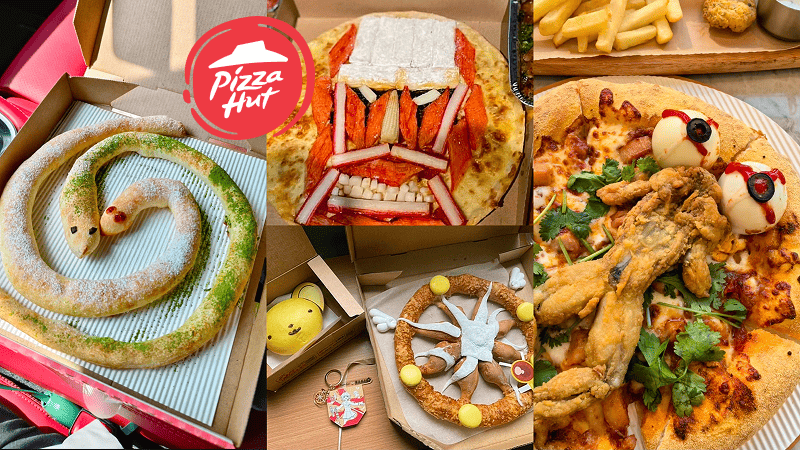
The recent viral example? A limited-edition product nicknamed the “Double Snake Pizza.”
Instead of a traditional round pie, customers received two long, snake-shaped strips — one pistachio flavored, one cheese. The marketing slogan referenced Chinese mythology in a way that left many consumers confused before they were even amused.
Social media exploded.
Some customers joked they needed “psychological preparation” before opening the box. Others posted side-by-side comparisons between the official product images and what actually arrived — calling it an “abstract blind box.”
Was it pretty? Not necessarily.
Was it edible? Yes.
Was it discussed? Absolutely.
And that’s the point. This wasn’t an isolated moment. Over the past few years, Pizza Hut China has built a reputation for experimental — sometimes borderline chaotic — menu creativity:
- Turtle-shaped pizzas topped with herbs and red bean paste
- Halloween “ghost hand” seafood creations
- Dumpling-and-pineapple combinations
- Bubble tea pearls on pizza
- Fried frog placed at the center of a collaboration pizza
- Candy, popping sugar, and rose powder toppings
Some products were polarizing. Some became cult favorites. Many went viral regardless.
To outsiders, it looked reckless. To marketers, it looked deliberate.
Because in an era where attention equals currency, controversy is often cheaper than traditional advertising.

Source: 小红书@無鐵炮
A Market That Shrunk — and Got Louder
Behind the theatrics is a harder reality.
According to industry data from Euromonitor, pizza’s penetration rate in China’s overall dining consumption fell from 3.2% in 2020 to 2.7% in 2024. The category isn’t expanding the way hotpot, coffee, or tea chains are.
Meanwhile, competitors are scaling aggressively:
- Domino’s China reported RMB 4.314 billion in revenue in 2024, up 41.4% year-on-year. It opened 240 new stores and achieved 30 consecutive quarters of same-store sales growth.
- Saizeriya, the Japanese value Italian chain, continues to thrive in China’s price-sensitive environment, with over 400 mainland stores and strong annual revenue growth.
In contrast, Pizza Hut — which entered China in 1990 and once defined Western casual dining for middle-class families — began to feel expensive, outdated, and out of sync with younger consumers.
Foot traffic slowed. Online sentiment turned ironic.
It wasn’t collapsing — but it wasn’t leading either.
Something had to change.

Source: 小红书@翠花
Enter “WOW”: The Price Reset
Instead of defending its old positioning, Pizza Hut chose something radical.
It lowered prices.
In May last year, Pizza Hut opened its first Pizza Hut WOW concept store in Guangzhou. The model directly targeted value players like Saizeriya.
Prices shocked longtime customers:
- Pasta for RMB 15
- Fried chicken for RMB 9
- Pizza for RMB 21
This was a dramatic departure from its previous “slightly upscale Western dining” image.
Even more boldly, some WOW stores opened next door to competitors — signaling direct confrontation rather than avoidance.
By 2025, Pizza Hut announced broad menu price cuts across 30 items. Off-peak promotions dropped prices as low as RMB 9.9 during afternoon tea hours, under the slogan “No gimmicks, one fixed price.”
The results?
- Over 200 WOW stores opened
- Pizza priced under RMB 50 saw 50% year-on-year sales growth in 2024
- Yum China signaled further expansion of the format
For a brand many considered stagnant, this was a clear pivot.

Source: 小红书@天蓝年代
Localization on Overdrive
At the same time, Pizza Hut doubled down on hyper-localization.
Instead of defending “authentic Italian” identity, it embraced culinary mashups inspired by Chinese regional flavors:
- Duck-based pizzas inspired by Beijing roast traditions
- Mala (Sichuan spicy hotpot-style) pizza
- Regional noodle-inspired pasta series referencing cities like Wuhan, Chengdu, Fujian, Shanghai, and Suzhou
- Dim sum-inspired creations
- Ramen-style pizza collaborations
Some combinations raised eyebrows. Others surprisingly worked.
What mattered wasn’t purity — it was participation in local food culture conversations.
Pizza Hut stopped asking: “Is this Italian enough?”
It started asking: “Will this be talked about?”

Source: 小红书@momo(学cpa版)
Is It Madness — or Marketing?
To some observers, Pizza Hut’s recent years look like chaos.
To others, it looks like calculated provocation.
Internal marketing interviews have hinted that controversy is often part of the plan. If a product sparks debate even within internal teams, it’s likely to generate online discussion externally.
In today’s Chinese social media ecosystem — where novelty spreads faster than polish — a bizarre pizza can outperform a safe one.
And here’s the nuance:
While the internet laughs, it also orders.
Many viral items sell out quickly. Even critics admit curiosity drives purchase. A brand mocked is still a brand remembered.

Source: 小红书@小红薯AE46C539
The Bigger Picture: Reinvention, Not Randomness
Pizza Hut’s transformation can be summarized in three overlapping moves:
- Shock-driven product marketing to dominate online conversation
- Aggressive price restructuring to regain competitiveness
- Deep localization to stay culturally relevant
Is every experiment successful? No.
Is the brand stable? Increasingly, yes.
Most importantly, Pizza Hut China has escaped the worst fate in modern retail: irrelevance.

Source: 小红书@天蓝年代
From Legacy Brand to Loud Player
Thirty years ago, Pizza Hut symbolized aspirational Western dining in China.
Today, it’s something else — part meme, part marketing case study, part value competitor.
Its journey from “overpriced and fading” to “low-price, high-noise challenger” may not look elegant. But in a contracting category with aggressive rivals, elegance isn’t the goal.
Survival is.
And if that survival occasionally looks like snake-shaped pistachio bread?
Well — at least people are still opening the box.







Leave a comment
This site is protected by hCaptcha and the hCaptcha Privacy Policy and Terms of Service apply.