
By Sherry Fei | December 2025
In China, the day often begins not with silence but with steam.
Before the sun fully rises, morning markets are already alive—vendors lifting bamboo baskets, cleavers knocking rhythmically against cutting boards, bowls being stacked and unstacked in a soft, familiar clatter. Somewhere in this warm chaos, a pot of broth starts to boil, releasing a fragrance that is at once humble and irresistible.
It was in such a setting that Hangzhou, as my hometown, revealed itself to me when I get up early and decide to go to the morning markets: not through grand landmarks or well-known attractions, but through a bowl of noodles enjoyed at a wooden table behind a bustling market hall. The flavors were gentle, comforting, unmistakably local—an introduction to the city as honest as the morning light.

Source: the author
Where Is Hangzhou? A City Defined by Its Soft Mornings
Located in eastern China, not far from Shanghai, Hangzhou is often known for its scenery—the willow-lined shores of Xi Lake (West Lake in China), classical gardens, and tea fields rising toward the hills. Yet beyond these famous landscapes lies a daily rhythm shaped by food, especially noodles.
Here, noodle shops are not just places to eat. They are part of the city’s pulse, marking the start of the day for students, office workers, market vendors, grandparents, and children. And at the center of this morning ritual are three classic dishes beloved across Hangzhou.

Source: http://xhslink.com/o/Axd9ZS4qHBK
Hangzhou Noodles: The Three Classics of a Morning Meal
Pian’er Chuan — The Taste of Home
Among all the noodles in Hangzhou, Pian’er Chuan holds a special place.
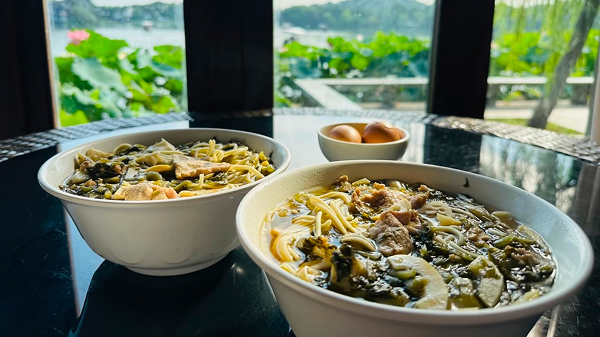
It is built on three simple ingredients—snow vegetables, bamboo shoots, and thin slices of pork—combined into a clear, delicate broth that feels almost medicinal in its purity. Despite its modest appearance, this dish is so deeply tied to local taste memory that many Hangzhou residents instinctively seek it out at the start of the day.
There is nothing dramatic about Pian’er Chuan. Its quiet flavor is precisely what makes it a comforting anchor in a rapidly changing city.

Source: the author
Ban Chuan — Flavor Without Broth
If Pian’er Chuan represents softness, then Ban Chuan offers warmth of another kind.
Ban Chuan stands out for its wok-fried aroma and satisfying texture. These alkaline noodles are first boiled, cooled, and then tossed in a smoking-hot wok with shredded pork, tofu strips, chives, soy sauce, and a touch of sugar. The result is a glossy, fragrant bowl that’s savory, slightly smoky, and deeply comforting — a flavor locals associate with home.
One charming detail that surprises many visitors is where the city’s most famous Ban Chuan shop is located: inside a local wet market. This spot has even earned a place in the Michelin Guide, drawing crowds of curious travelers who can’t quite believe that a humble market stall could be recognized alongside upscale restaurants. But that contrast — Michelin-level flavor in the most everyday setting — is exactly what makes Hangzhou’s noodle culture unforgettable.

Source: the author
Jiagong Mian — The Custom-Made Morning Noodle
At the heart of Hangzhou’s noodle culture lies Jiagong Mian, the “add-what-you-like” noodle.
Unlike other dishes with fixed recipes, this one is built around individual preference. A customer simply selects ingredients—greens, pork, mushrooms, tofu, offal, seafood, or fried toppings—and the cook assembles a bowl designed entirely around taste and mood.
Jiagong Mian reflects something essential about Hangzhou life: a gentle insistence on personal comfort, even in small, mundane moments.

Source: the author
The Morning Market: Where Hangzhou’s Best Noodles Live
Although Hangzhou has countless restaurants, many of the city’s most beloved noodle bowls are found inside its morning markets. Here, noodle shops open before dawn and often close when the ingredients run out.
The scene is both ordinary and quietly beautiful:
- Office workers slurping noodles before catching the subway
- Elderly shoppers finishing breakfast before choosing vegetables to take home
- Parents buying Pian’er Chuan for themselves while packing Ban Chuan or Jiagong Mian for their children
- Steam rising from pots, catching the early sunlight in soft, silvery clouds
In these markets, noodles are not a tourist attraction. They are a daily necessity, a shared habit, a comfort.
And in Hangzhou, breakfast is often carried home in warm plastic bags knotted neatly at the top—each bag holding a different kind of noodle chosen for someone waiting at home.

Source: http://xhslink.com/o/Axd9ZS4qHBK
Beyond Hangzhou: A Glimpse into China’s Noodle Universe
While Hangzhou’s breakfast noodle culture is uniquely comforting, China’s broader noodle tradition is astonishingly diverse. Among the many Chinese noodle types, a few regional specialties have become household names across the country.
In central China, Wuhan Hot Dry Noodles — or Re Gan Mian — stand as one of the nation’s most iconic Chinese dry noodles. Unlike soup-based varieties, these hot dry noodles are coated in sesame paste, soy sauce, chili oil, and pickled vegetables, creating a bold, fragrant bowl beloved by generations of Wuhan locals. For many travelers, tasting this distinctive Wuhan noodle dish is an essential part of understanding Hubei’s food culture.

Source: http://xhslink.com/o/7JddRH0Bogf
Far to the south, Hong Kong Cart Noodles offer a completely different experience. These customizable cart noodles — also known simply as Hong Kong noodle or cart noodle — allow diners to choose from a mix-and-match selection of toppings such as curry fish balls, beef brisket, pigskin, and daikon. Their playful, street-style nature captures the spirit of southern Chinese food culture: lively, flexible, and endlessly flavorful.

Source: http://xhslink.com/o/1c9EEzWKxOW

Source: http://xhslink.com/o/1J6sMJipItQ
In the north, Zhajiangmian stands as Beijing’s proud classic—thick wheat noodles topped with fermented soybean paste and crisp vegetables. Simple and assertive, it mirrors the straightforward temperament of the capital.

Source: http://xhslink.com/o/79yQQtqIE7r
Northern China contributes yet another classic to the world of dried noodles: the hand-carved Shanxi Knife-Cut Noodles, known for their thick, chewy texture and the dramatic slicing technique used by skilled noodle masters. This style represents the heartier, wheat-forward character of northern Chinese cuisine.

Source: http://xhslink.com/o/7cryPLWHxw
Together, these dishes highlight the incredible range of flavors within China’s noodle heritage — from sesame-rich dry noodle bowls to vibrant Hong Kong cart noodles and rustic northern wheat noodles.
Why Noodles Matter in China
Across the country, noodles do more than satisfy hunger.
They express local identity—whether through Hangzhou’s gentle flavors, Beijing’s strong contrasts, Wuhan’s intensity, or Hong Kong’s freedom. Each bowl carries the geography, climate, temperament, and memory of the people who prepare and eat it.
In Hangzhou, morning noodles are especially meaningful.
They frame the day, soften early hours, and knit together generations—students, workers, parents, vendors—through a shared, familiar ritual.
It’s also worth mentioning a small but meaningful tradition shared across China: eating noodles on one’s birthday. Known as longevity noodles, these long, unbroken strands symbolize a wish for a long life. Whether served in a simple broth or prepared as a stir-fried bowl, the idea remains the same—on your birthday, you don’t just eat noodles; you take in a blessing.

Source: the author
Conclusion
A bowl of noodles in China is never just a meal.
It is a window into a city’s rhythm, a reflection of its people, and a quiet keeper of local heritage. From the delicate Pian’er Chuan and fragrant Ban Chuan to the customizable Jiagong Mian found in Hangzhou’s morning markets, each dish offers a glimpse into the gentle, unhurried soul of the city. Beyond Hangzhou, noodle traditions like Shanxi’s knife-cut noodles, Wuhan’s hot dry noodles, Hong Kong’s cart noodles, and Beijing’s zhajiangmian reveal the diversity of flavors that shape daily life across China.
For travelers who want to experience China’s noodle culture up close—especially the unforgettable breakfast noodles inside Hangzhou’s lively local markets—you’re welcome to explore the city with me through Bridge to Locals.
I’ll take you to the most authentic neighborhood markets, where we’ll pick fresh ingredients together, find the stall that locals swear by, and hand everything to the chef. What follows is a bowl of Jiagong Mian—a made-to-order Hangzhou noodle dish that exists nowhere else in the world.
Come hungry, come curious, and let’s discover the true flavor of Hangzhou, one bowl at a time.






Leave a comment
This site is protected by hCaptcha and the hCaptcha Privacy Policy and Terms of Service apply.